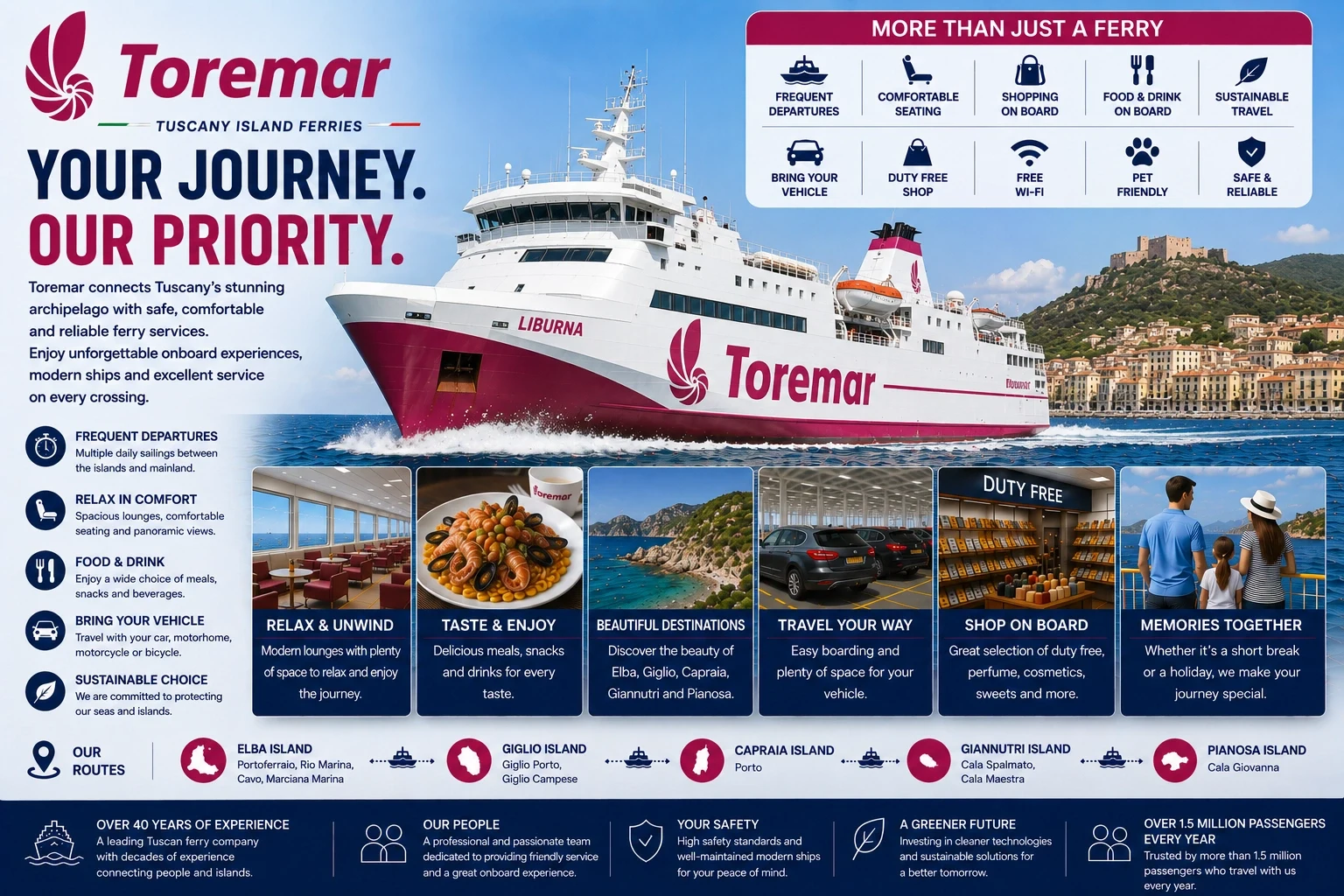
Compare Toremar services with EUFerry, from route planning and onboard considerations to current
departure availability and fares for your chosen journey.
Tuscan islands Vehicle ferries Fast passenger hydrofoils
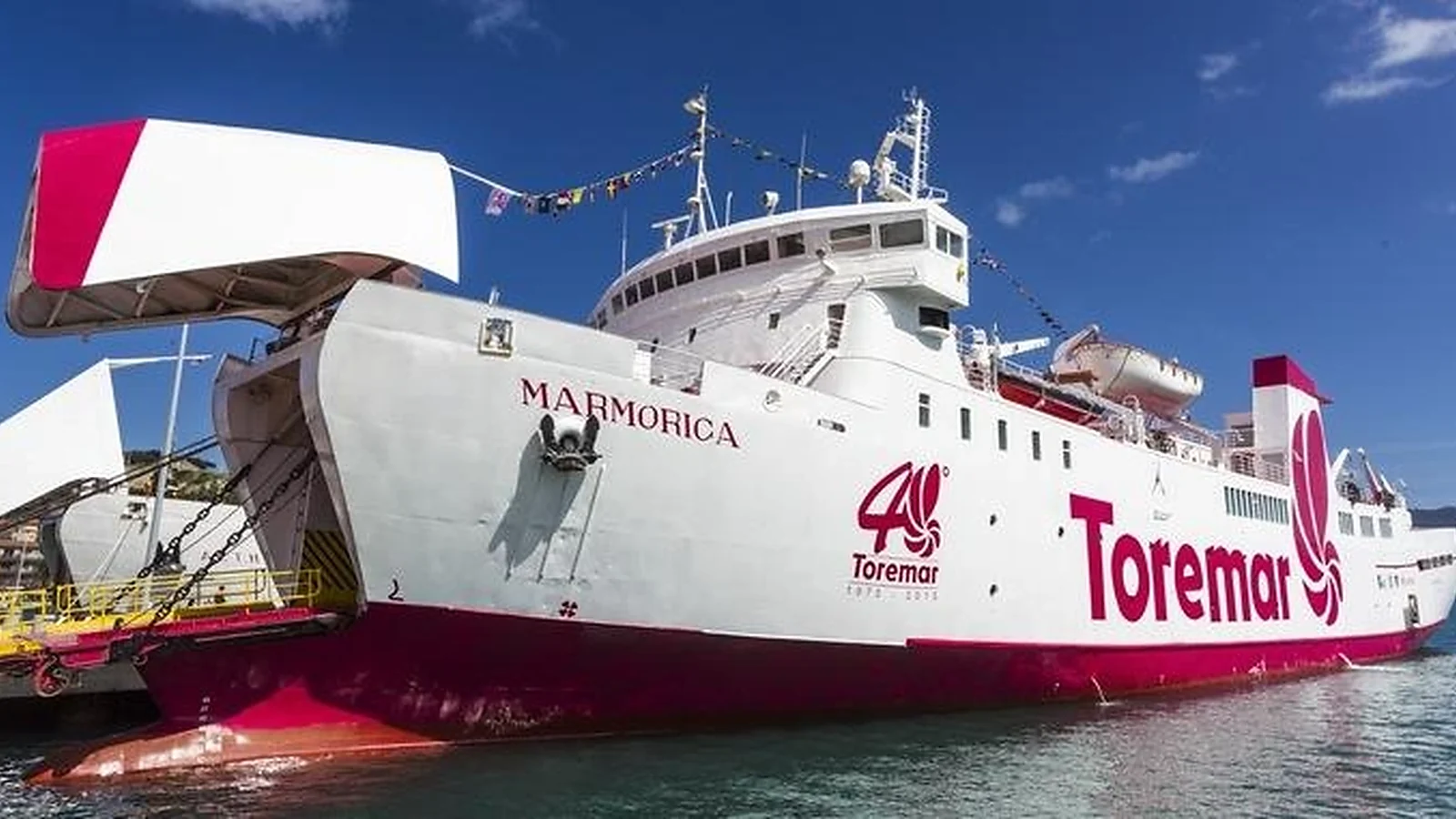
The public ferry link across the Tuscan Archipelago
Toremar provides regional ferry connections between mainland Tuscany and the islands of the Tuscan
Archipelago. Elba is the busiest part of the network, with frequent services from Piombino to
Portoferraio, Rio Marina and Cavo.
The operator also serves smaller and more remote islands including Capraia, Gorgona, Pianosa, Giglio
and Giannutri. Some of those connections operate only on specific days, so travellers should check
the dated timetable before arranging accommodation or onward transfers.
Toremar uses both conventional vehicle ferries and fast passenger-only hydrofoils. That distinction
matters: a 20-minute Piombino–Cavo hydrofoil is very different from a conventional car ferry to
Portoferraio, even when both serve Elba.
EUFerry travel note: choose the Elba arrival port around where you are staying. Portoferraio, Rio Marina and Cavo serve different sides of the island.
Representative routes across Elba and the archipelago
Toremar routes
The network is larger than three routes, so these cards show a conventional Elba car ferry, a fast
passenger crossing and one of the wider archipelago services.
About 1 hourVehicle ferry
Tuscany
Piombino
Elba
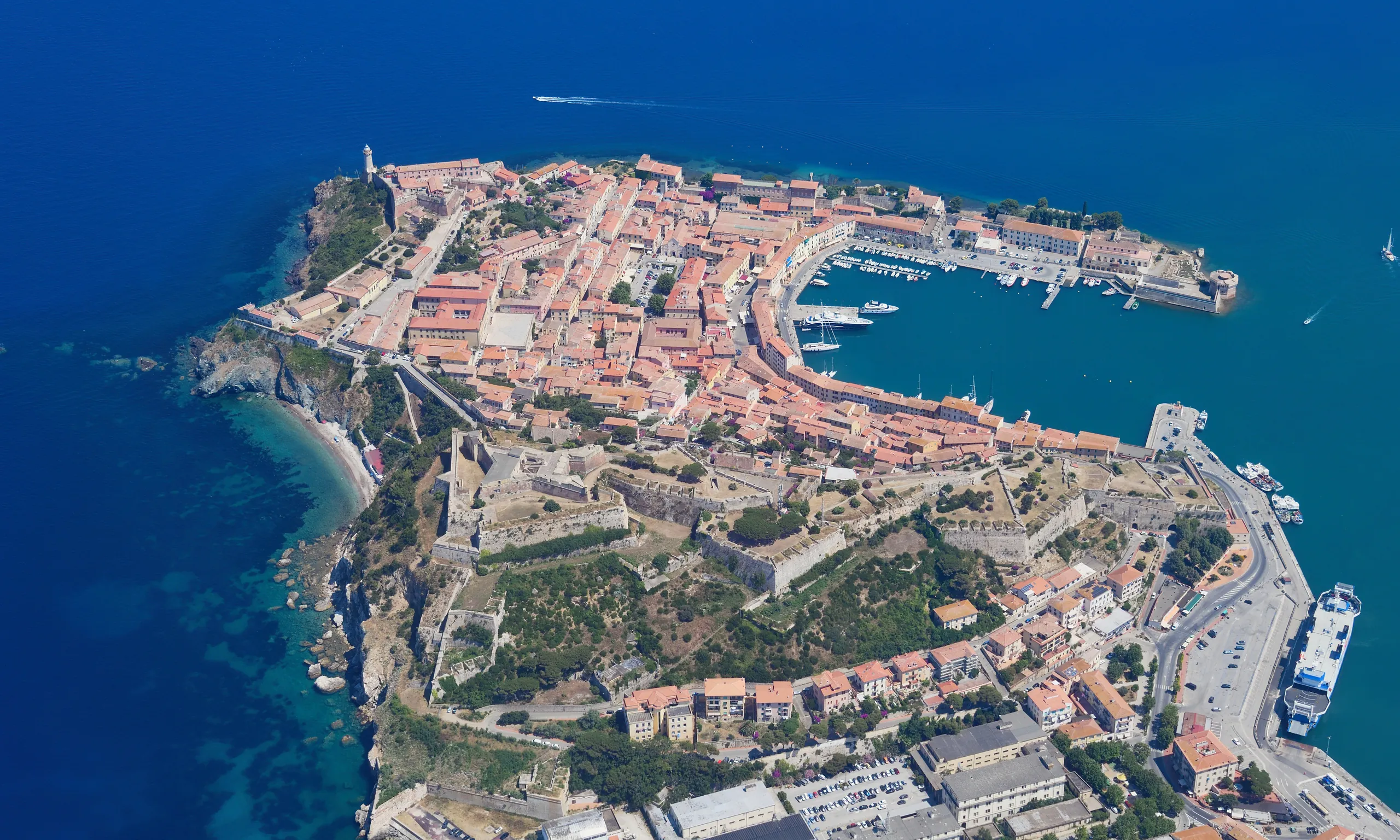
Portoferraio
Piombino–Portoferraio is Toremar's principal conventional Elba crossing and takes about one hour. It
carries foot passengers and vehicles.
Frequent route to Elba's main town
Cars, motorcycles and touring vehicles accepted on vehicle sailings
Hydrofoil alternatives can make the journey in about 40 minutes
Livorno–Capraia takes about 2 hours 45 minutes and demonstrates Toremar's role beyond Elba, linking
the mainland with one of the archipelago's more remote islands.
Operates on selected days rather than a constant shuttle pattern
Check the dated timetable before arranging island accommodation
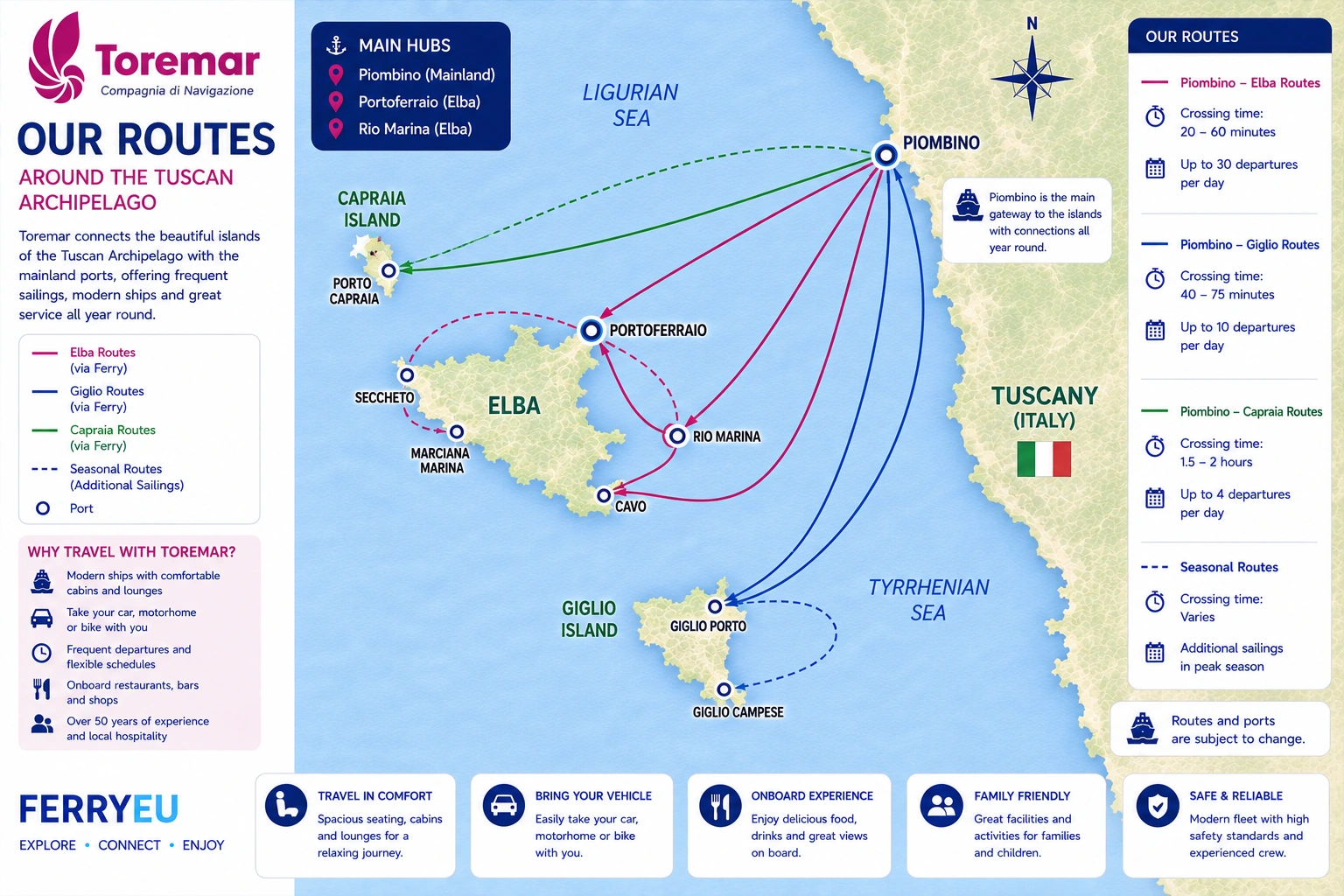
The original EUFerry Toremar route map shows the broad island network. Current routes include
Piombino links to Portoferraio, Rio Marina, Cavo and Pianosa; Livorno links to Capraia and Gorgona;
and Porto Santo Stefano links to Giglio and Giannutri.
Some smaller-island sailings operate only on selected days, so the map should be treated as
geographic orientation rather than a daily service promise.
After choosing the most practical route, compare the live Toremar sailing for departure time,
calling pattern, passenger requirements and the facilities or accommodation shown for that service.
The complete itinerary and arrival location can matter more than a small difference in the headline
fare.
The fast Cavo and some Portoferraio services are hydrofoils and carry passengers only. Check the
transport type if travelling with a vehicle.
Illustrative Toremar route map — verify the live timetable for the selected island and date.
Mainland and island gateways
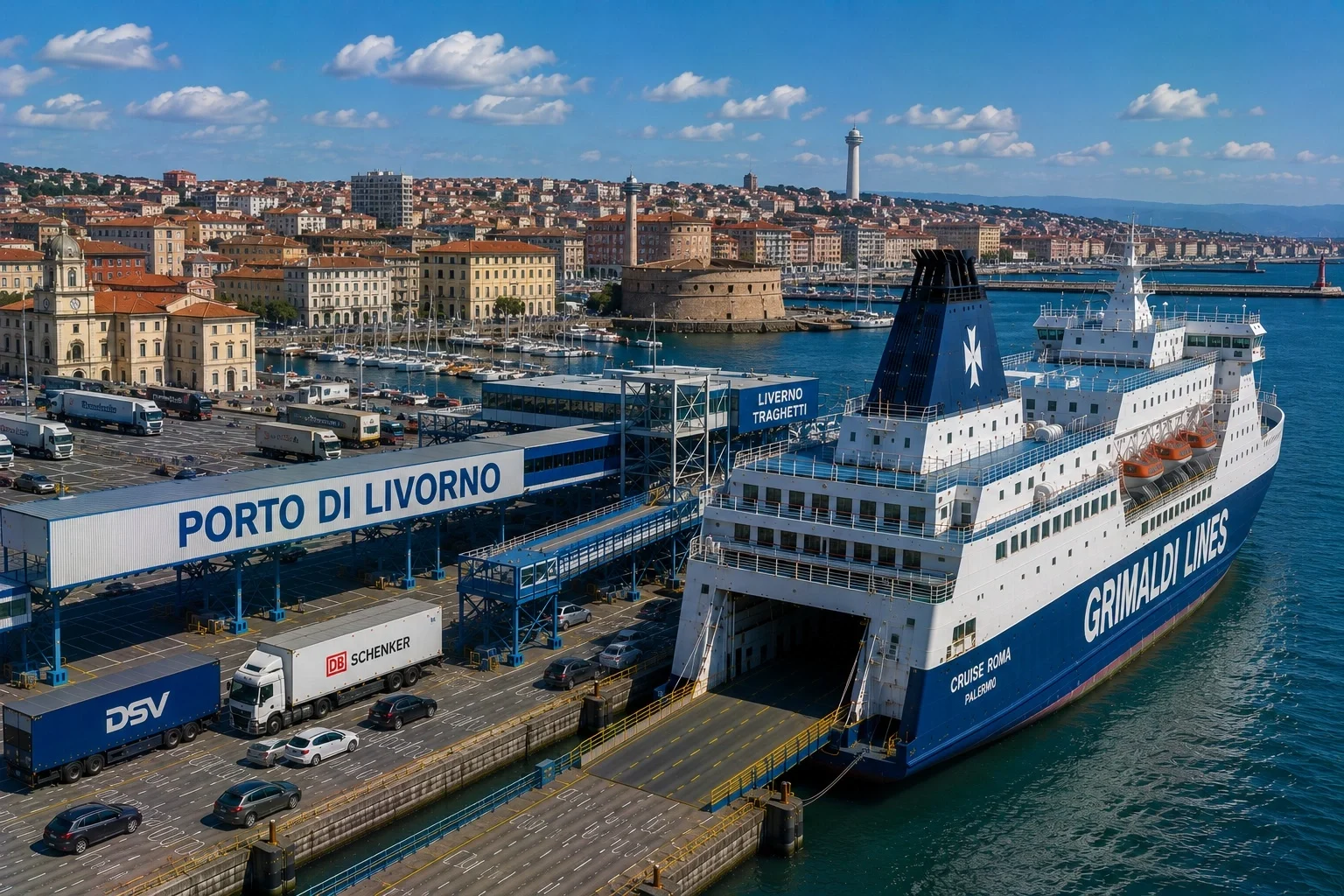
Piombino, Portoferraio and Livorno
These three ports explain most mainland approaches to Toremar's network and use the EUFerry
port-image library.
Main Elba gateway
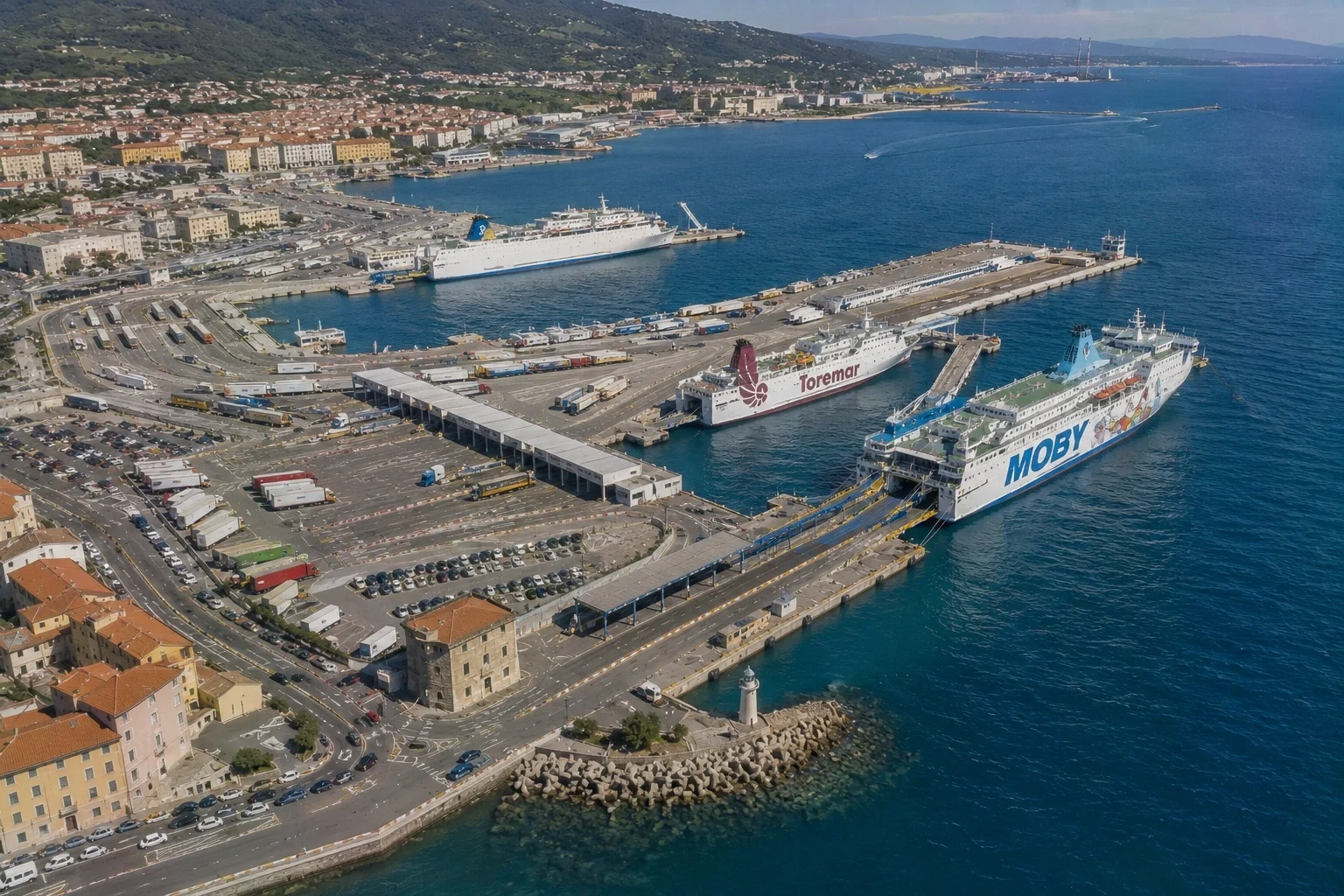
Piombino
Piombino is the principal mainland port for Elba, with routes to Portoferraio, Rio Marina, Cavo and
selected Pianosa services.
Portoferraio, Rio Marina and Cavo are all on Elba but serve different sides of the island. Choose
the route around your accommodation rather than automatically booking the busiest port.
Short regional crossings
Passenger seating and comfort
Toremar crossings are regional rather than overnight journeys, so the focus is on comfortable
lounges, open decks and passenger seating rather than private cabins.
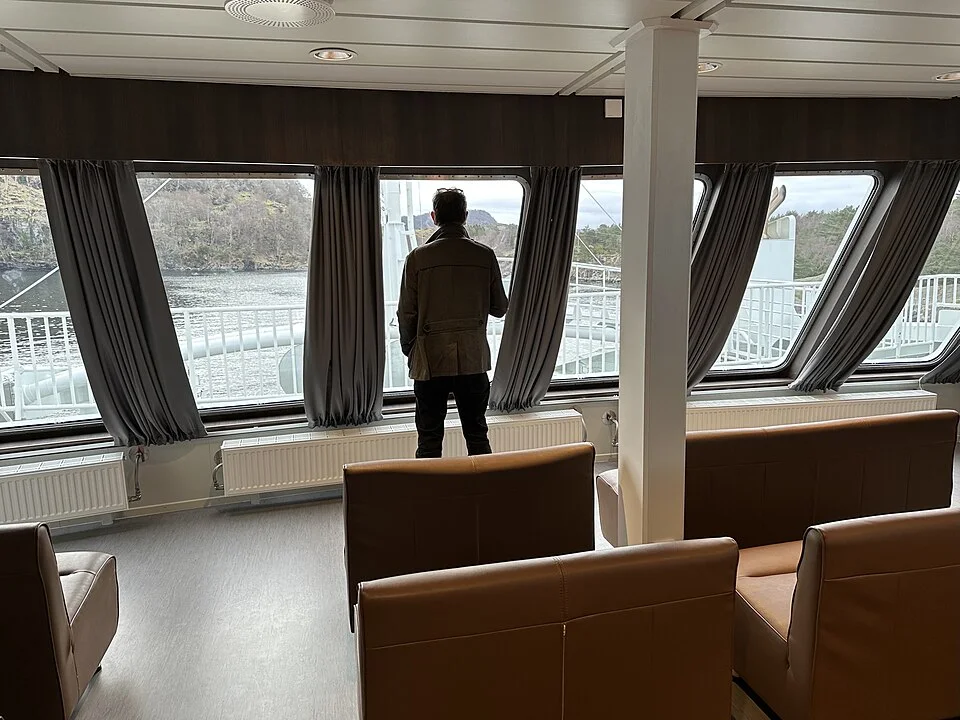
Conventional ferries provide indoor passenger lounges for short island crossings. Open decks are useful for fresh air and views across the Tuscan coast.
General ferry lounges
Conventional vessels provide air-conditioned indoor passenger areas with standard seating.
Best considered forPiombino, Livorno and Porto Santo Stefano ferry routes
Hydrofoil seating
Fast passenger craft use air-conditioned seated saloons designed around short journey times rather
than roaming public spaces.
Best considered forPiombino–Cavo and fast Portoferraio services
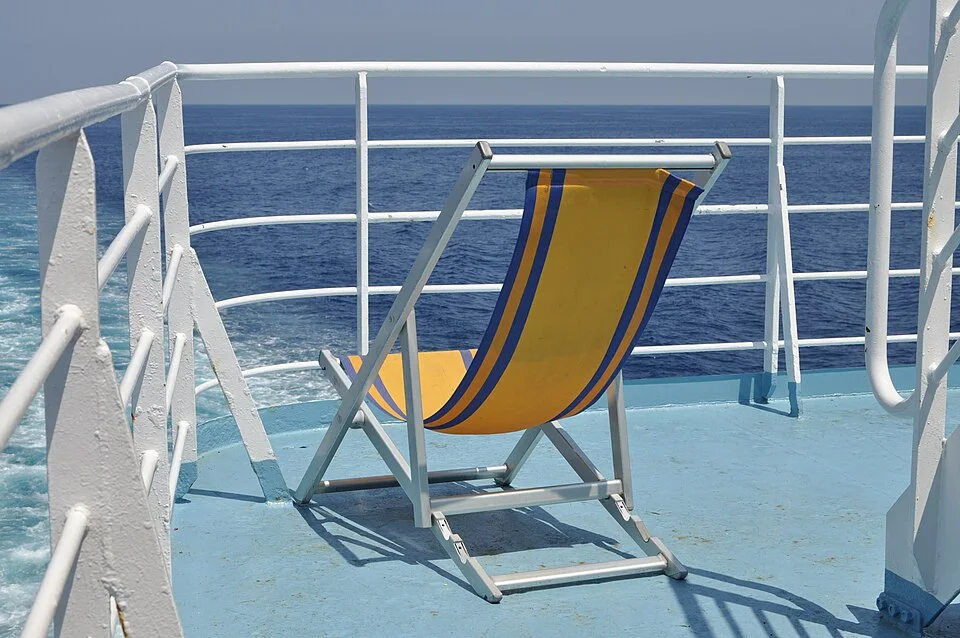
Open decks
Passengers on conventional ferries can use permitted outdoor deck areas when weather conditions allow.
Best considered forSea views and fresh air
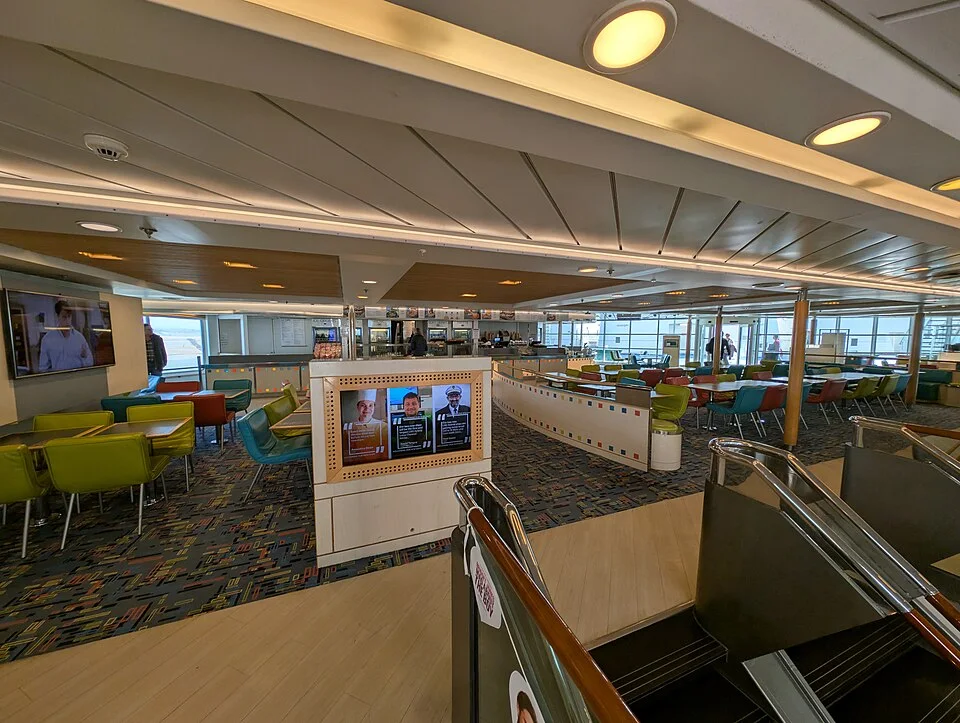
Simple onboard refreshment
Facility levels vary by vessel, with longer conventional routes offering more opportunity for drinks
or snacks than very short hydrofoil trips.
Best considered forLonger archipelago crossings
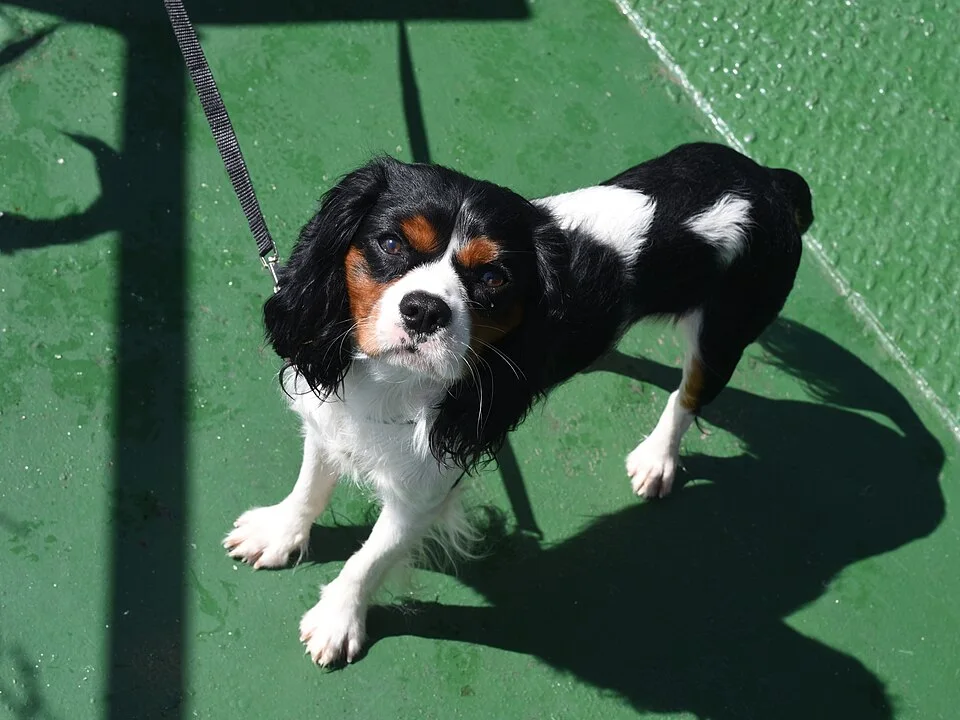
Pet-permitted outdoor areas
Pets are not normally admitted to passenger lounges and use permitted outdoor deck spaces or
designated kennels where available.
Best considered forPassengers travelling with animals
Assisted passenger seating
Toremar gives priority boarding and free assistance to passengers with reduced mobility, subject to
advance notice where required.
Best considered forPassengers needing boarding support
Short-crossing tip
On a 20- to 60-minute Elba crossing, the key choice is usually vehicle ferry versus fast passenger
craft, not a premium accommodation category.
Simple facilities for regional journeys
Lounges, Wi-Fi, open decks and practical services
Toremar's onboard offer is designed around short regional transport rather than cruise-ferry
entertainment, with the exact facilities determined by vessel type.
Indoor lounges provide the core passenger space on conventional ferries. Selected vessels provide simple refreshments for the crossing. Open decks offer views of Elba and the Tuscan coast on conventional ships. Pets use permitted deck areas or designated accommodation rather than ordinary lounges.
Air-conditioned lounges
Toremar vessels provide indoor passenger spaces suitable for short regional crossings.
Wi-Fi on selected craft
Some Toremar vessels, including Schiopparello Jet, provide free onboard Wi-Fi.
Open decks
Conventional ferries provide outside spaces for sea views and fresh air when conditions permit.
Refreshments
Onboard food and drink facilities vary by vessel and are more limited than on long-distance cruise ferries.
Pet areas
Dogs and small animals travel under Toremar's deck, kennel and carrier rules.
Assisted travel
Free assistance is provided to passengers with disabilities or reduced mobility in cooperation with
port authorities.
Images in this section are from EUFerry's general ferry-travel library and illustrate facility
types. The operator-specific hero and overview images use Toremar imagery.
Vehicle ferry, hydrofoil, pet or assistance
Vehicles, pets and accessibility
Toremar's route mix means the first question is whether the selected sailing carries vehicles at
all. Passenger-only hydrofoils and conventional vehicle ferries operate side by side.
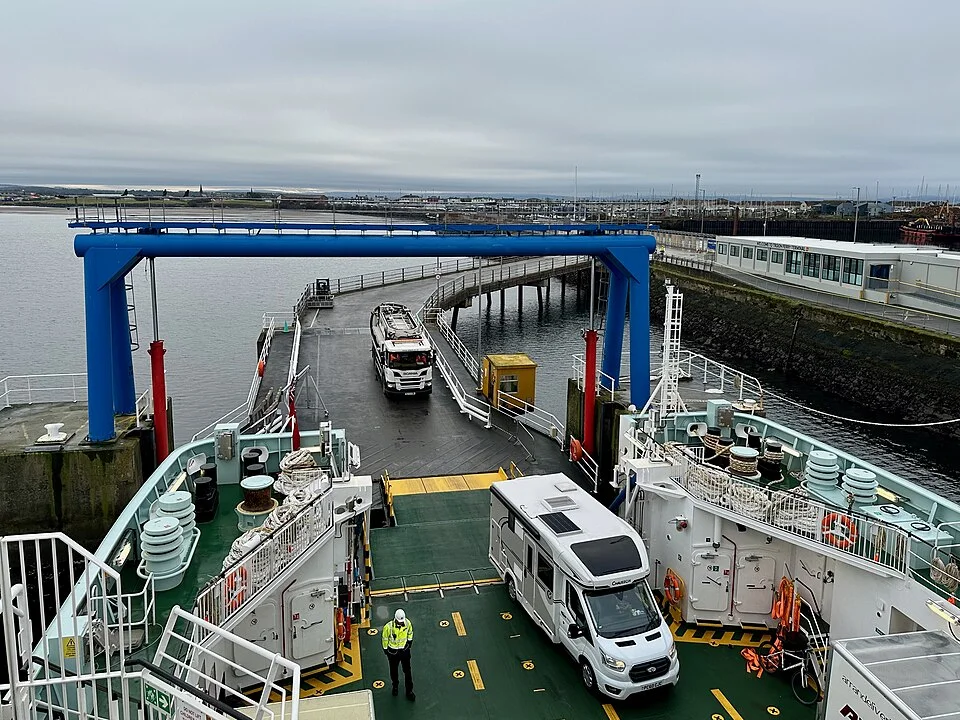
Motorhomes and cars can travel on vehicle-carrying Toremar ferries. Vehicle spaces can be reserved in advance on eligible routes. Pets are accepted subject to lead, muzzle and carrier rules.
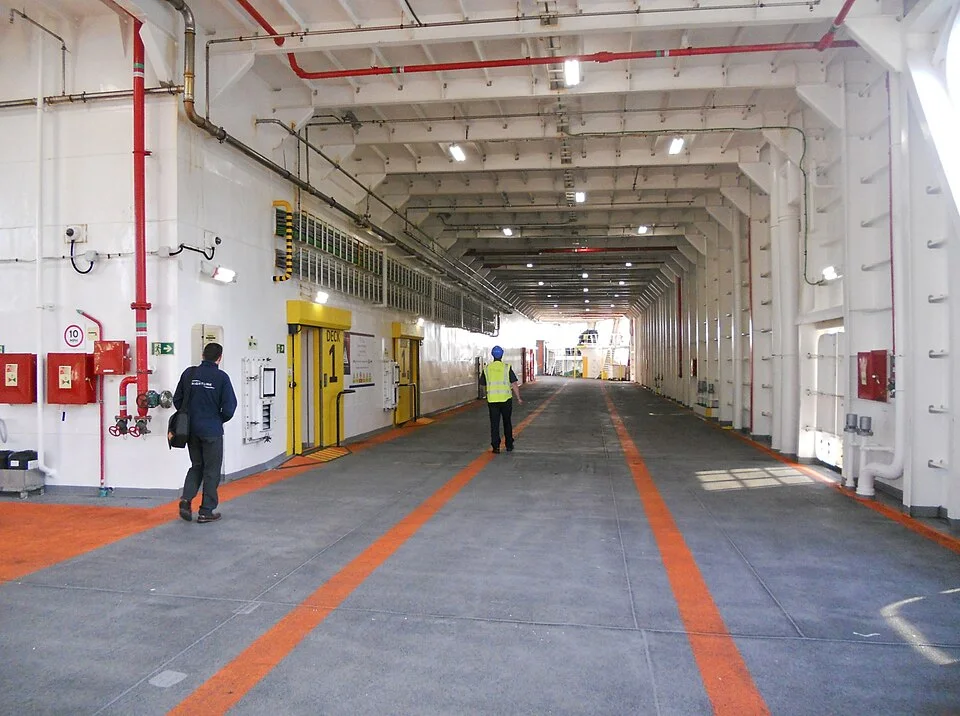
Cars and motorcycles
Cars and motorcycles are accepted on conventional ferries where vehicle space is offered.
Book vehicle space in advance where possible
Hydrofoils are passenger-only
Follow crew instructions during loading and parking
Motorhomes, caravans and trailers
Larger touring vehicles can be booked on eligible ferries subject to dimensions, route restrictions
and garage capacity.
Enter full length and height
Include trailers and external equipment
Check island vehicle restrictions independently of ferry availability
Travelling with pets
Dogs, cats and other small pets are accepted. Dogs must be muzzled and kept on a lead, while smaller
animals travel in a suitable carrier.
Pets are normally excluded from passenger lounges
Use permitted outdoor areas or kennels where provided
Bring the ticket and any required health documentation
Reduced mobility and assistance
Toremar gives priority boarding and free assistance to passengers with reduced mobility.
Declare assistance needs when booking
Request assistance at least 48 hours before departure
If no special time is given, arrive at least 30 minutes before departure
Short routes still have a firm presentation time
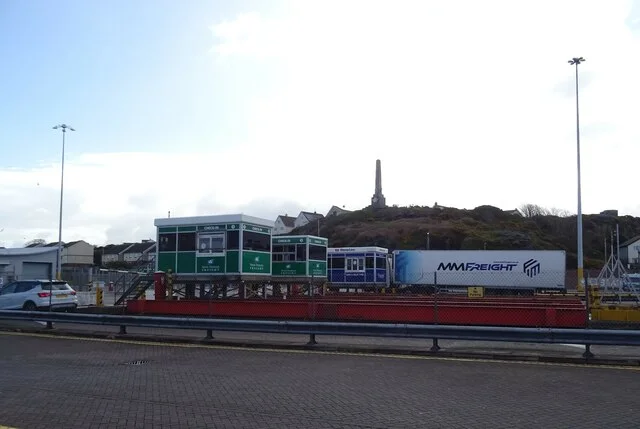
Check-in, luggage and boarding
Toremar asks passengers, including those travelling with vehicles, to present themselves at the
embarkation point with a valid ticket at least 30 minutes before departure.
Keep your ticket and any required passenger or vehicle documents ready before joining the boarding process. Vehicle and foot-passenger boarding procedures vary between conventional ferries and hydrofoils.
Recommended travel sequence
Before travel
Check the service type
Confirm whether your departure is a vehicle ferry or passenger-only hydrofoil and whether the route
operates every day or only on selected dates.
Before leaving
Check for timetable variations
Toremar advises passengers holding tickets issued before the travel day to confirm that no
operational change has occurred.
30 minutes before
Minimum presentation time
Passengers and vehicles should be at the embarkation point at least 30 minutes before departure.
Boarding cannot be guaranteed after that point.
At vehicle boarding
Follow the captain and crew's instructions
Vehicles are loaded according to operational requirements, with handbrake and gear engaged and
alarms switched off.
After boarding
Keep short-journey essentials with you
Even on a brief crossing, keep tickets, phones, medicines and valuables accessible rather than
buried in luggage.
Choose the port around the island
When Toremar can be the practical choice
Toremar is especially useful for travellers who want flexibility on Elba. Piombino connects with
Portoferraio, Rio Marina and Cavo, allowing the ferry arrival to match the part of the island where
you are staying.
For foot passengers, the fast hydrofoil can significantly reduce crossing time. For travellers
taking a car or motorhome, the conventional ferry is the relevant choice and vehicle space should be
reserved in busy periods.
The wider archipelago services are more specialised. Capraia, Gorgona, Pianosa, Giglio and Giannutri
can have much less frequent schedules than Elba, so itinerary planning should start with the ferry
timetable rather than the hotel.
Common planning questions
Toremar FAQs
Which routes does Toremar operate?
Toremar connects mainland Tuscany with Elba and the wider Tuscan Archipelago. Current routes include
Piombino–Portoferraio, Piombino–Rio Marina, Piombino–Cavo, Piombino–Pianosa, Livorno–Capraia,
Livorno–Gorgona, Porto Santo Stefano–Giglio, Porto Santo Stefano–Giannutri and inter-island services
such as Rio Marina–Pianosa.
How long is the Piombino to Portoferraio ferry?
The conventional Toremar ferry takes about one hour between Piombino and Portoferraio. A
passenger-only hydrofoil service can make the crossing in about 40 minutes.
How long is Piombino to Rio Marina?
The Piombino–Rio Marina ferry takes about 45 minutes on the current Toremar route information.
How long is Piombino to Cavo?
The passenger-only hydrofoil service from Piombino to Cavo takes about 20 minutes.
How early should I arrive for Toremar?
Toremar asks passengers, including those with vehicles, to present themselves at the embarkation
point with a valid ticket at least 30 minutes before departure. Boarding cannot be guaranteed after
that time.
Can I take a car or motorhome on Toremar?
Yes on vehicle-carrying ferries. Cars, motorcycles, motorhomes, caravans, trailers and other
suitable vehicles can be booked subject to the route, vessel and available garage space. Hydrofoil
services are passenger-only.
Can I travel with a pet?
Yes. Toremar allows dogs, cats and other small animals. Dogs must be on a lead and muzzled, while
smaller animals must travel in a suitable carrier. Pets are normally restricted from passenger
lounges and use permitted external decks or designated areas.
How much luggage can I take?
Toremar's current conditions allow each full-fare passenger up to 20 kg of hand luggage on
conventional ferries and 10 kg on high-speed craft. Children travelling at half fare receive half
the standard allowance.
Does Toremar provide accessibility assistance?
Yes. Passengers requiring assistance should declare their needs when booking and request the
required help at least 48 hours before departure. Toremar provides free assistance in cooperation
with port authorities.
Does Toremar only serve Elba?
No. Elba is the busiest part of the network, but Toremar also serves Capraia, Gorgona, Pianosa,
Giglio and Giannutri within the Tuscan Archipelago.
Facility photographs are examples; the vessels shown are identified below. Facilities vary by ship.
250120 1029 MV Glen Sannox loading, Port of Troon ferry terminal.jpg — Dave souza; CC BY-SA 4.0. Source: https://commons.wikimedia.org/wiki/File:250120_1029_MV_Glen_Sannox_loading,_Port_of_Troon_ferry_terminal.jpg. Licence: https://creativecommons.org/licenses/by-sa/4.0. Resized for display.
Cavalier King Charles Spaniel (49687542022).jpg — Chris Hunkeler from Carlsbad, California, USA; CC BY-SA 2.0. Source: https://commons.wikimedia.org/wiki/File:Cavalier_King_Charles_Spaniel_(49687542022).jpg. Licence: https://creativecommons.org/licenses/by-sa/2.0. Resized for display.
Check-in, Holyhead Ferry Terminal - geograph.org.uk - 7757104.jpg — JThomas; CC BY-SA 2.0. Source: https://commons.wikimedia.org/wiki/File:Check-in,_Holyhead_Ferry_Terminal_-_geograph.org.uk_-_7757104.jpg. Licence: https://creativecommons.org/licenses/by-sa/2.0. Resized for display.
Deckchair on ferry.jpg — User:Amada44; CC BY 3.0. Source: https://commons.wikimedia.org/wiki/File:Deckchair_on_ferry.jpg. Licence: https://creativecommons.org/licenses/by/3.0. Resized for display.
Vehicle deck on the Victoria of Wight (Wightlink ferry).jpg — ITookSomePhotos; CC BY-SA 4.0. Source: https://commons.wikimedia.org/wiki/File:Vehicle_deck_on_the_Victoria_of_Wight_(Wightlink_ferry).jpg. Licence: https://creativecommons.org/licenses/by-sa/4.0. Resized for display.



 Tuscan islands
 Vehicle ferries
 Fast passenger hydrofoils